

Circadian lighting smart home retrofits are no longer a futuristic concept reserved for high end wellness clinics or biohacking enthusiasts. In 2026, you can equip an ordinary house with spectrally tuned, automatically scheduled lighting that supports your body’s internal clock. But the gap between marketing claims and real biological impact is wide. This guide separates the two, giving you the specs, cost estimates, integration realities, and automation recipes you need to make an informed decision.
We have tracked the market data, examined the protocols that matter, and identified the failure points most installers and homeowners encounter. Whether you are planning a single room pilot or a whole home retrofit, the following sections give you a practical, evidence backed roadmap.
Key Takeaways
- True circadian lighting targets the 480 nm melanopic sensitivity peak using multi channel fixtures, not just two channel tunable white bulbs with a wide CCT range.
- Retrofit costs in 2026 can scale from a $60 per room DIY pilot to $18 to $55 per sq ft for professionally commissioned networked systems, with healthcare grade installs adding a 25 to 40 percent premium.
- Matter compatibility, dynamic scheduling, and proper commissioning with melanopic verification are the three non negotiable pillars that separate effective installations from expensive disappointments.
- What is circadian lighting and why it matters for smart homes
- The science: how spectrally and temporally tuned light affects sleep, mood, and productivity
- Market snapshot 2026: why now is the time to retrofit
- Specs that separate true human centric lighting from marketing fluff
- Common product architectures and what to buy
- Average retrofit cost expectations (2026) and how to estimate residential budgets
- Top user complaints and real world failure modes, and how to avoid them
- Integration with smart home ecosystems and the role of Matter
- Installation and commissioning checklist
- Design patterns and automation recipes
- Emerging topics and gaps competitors miss
- Product evaluation cheat sheet
- Quick FAQs and next steps for homeowners
- Conclusion: ROI considerations and when to call a pro
What is circadian lighting and why it matters for smart homes
Your retina contains intrinsically photosensitive retinal ganglion cells (ipRGCs) that are most sensitive to light near 480 nanometers. These cells do not process images. They feed directly into the suprachiasmatic nucleus, your brain’s master clock, regulating melatonin production, alertness, and sleep timing. Circadian lighting uses spectrally and temporally tuned electric light to stimulate or suppress this pathway at the right times of day.
Tunable white is the hardware technology that shifts correlated color temperature, typically from warm amber to cool blue white. Circadian lighting is the application layer that deploys tunable white with specific spectral content, intensity levels, and automated scheduling to produce a physiological outcome. Many products advertise tunable white and call themselves circadian, but without melanopic calibration, multi channel spectral mixing, and dynamic automation, they are just adjustable color temperature lamps with no proven biological effect.
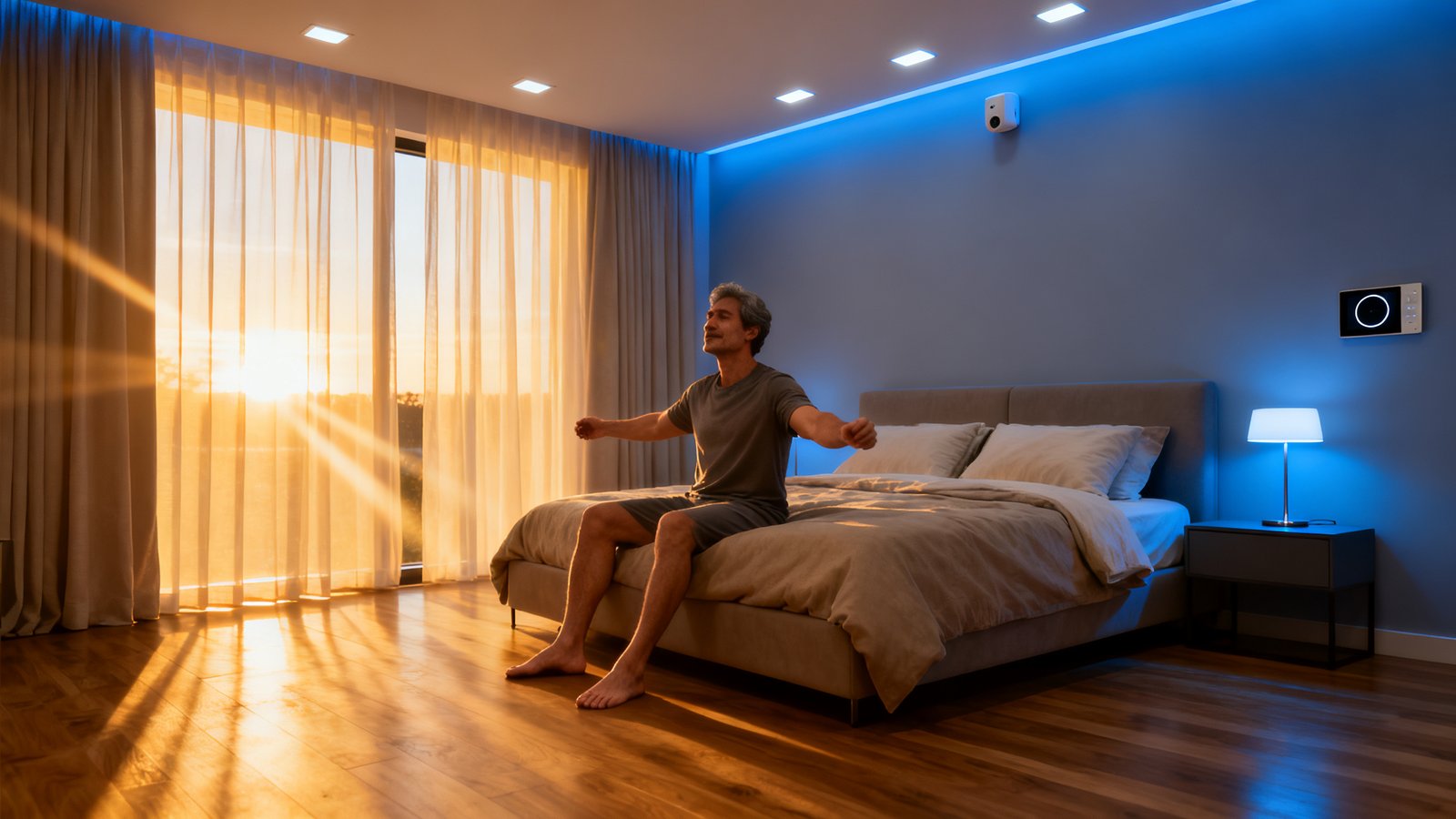
A genuine circadian system targets the ipRGC sensitivity peak near 480 nm for effective entrainment. This means evaluating products based on their melanopic output, not just their advertised kelvin range. The distinction matters because a bulb that shifts from 2700K to 6500K but lacks spectral precision in the melanopic band may feel different without actually shifting your circadian phase.
The science: how spectrally and temporally tuned light affects sleep, mood, and productivity
Morning exposure to high melanopic stimulus, typically from cool white light in the 5000K to 6500K range with strong 480 nm output, suppresses melatonin, raises cortisol, and sharpens alertness. This morning pulse is the single most important circadian signal. Without it, your internal clock drifts later, making it harder to fall asleep at night and harder to wake up the next morning.
Daytime maintenance dosing keeps alertness and cognitive performance elevated. Afternoon light with moderate melanopic content helps sustain focus and mood. Then, roughly two to three hours before bed, the system must reduce melanopic stimulus dramatically. Warm light below 3000K with minimal blue content allows natural melatonin onset. Systems that calibrate to melanopic daylight equivalent illuminance (MEDI) metrics focus specifically on the 480 nm sensitivity curve to achieve this progression.
Measurable outcomes from properly implemented circadian lighting include faster sleep onset, improved sleep efficiency, better morning alertness, and reduced evening anxiety. Studies in office and healthcare environments show measurable gains in daytime performance and mood when lighting follows this temporal and spectral pattern. The same principles apply in residential settings when the system is correctly specified and commissioned.
Market snapshot 2026: why now is the time to retrofit
The global human centric lighting market is projected at $5.2 billion in 2026, growing to $25 billion by 2034 at a compound annual growth rate of roughly 21.7 percent, according to Fortune Business Insights. The residential segment held a 19.6 percent share in 2025, and online distribution channels are expanding at a projected 15.3 percent CAGR through 2034, making pilot purchases and incremental upgrades more accessible than ever.
LED products dominate the circadian segment with approximately 62.4 percent market share in 2025. The technology maturity, falling component costs, and widespread adoption of wireless protocols like Matter, Zigbee, and Bluetooth Mesh have lowered the barrier for residential retrofits dramatically compared to even three years ago. Product availability is no longer the bottleneck. The bottleneck is specification knowledge and commissioning discipline.
Specs that separate true human centric lighting from marketing fluff
Many products claim circadian support. Here is the concrete specification checklist that separates genuine systems from cosmetic tunable white.
A real circadian system shifts from roughly 5000K to 6500K in the morning down to 2700K to 3500K in the evening, but CCT range alone is insufficient. The system must deliver CRI above 95 and R9 values exceeding 90 to render skin tones and colors naturally while providing spectrally accurate output. Advanced tunable white products achieve this through multi channel LED mixing, typically combining warm white, cool white, amber, red, and sometimes cyan emitters, going well beyond basic two channel warm/cool configurations.
Melanopic metrics are the defining differentiator. Systems should provide MEDI values or melanopic ratio data referenced to the 480 nm ipRGC sensitivity peak. Without this, you cannot verify that the evening mode actually suppresses melanopic stimulus enough to protect melatonin onset. Dynamic scheduling capability is mandatory. A system that only offers manual presets or static scenes does not qualify as circadian. The schedule must automatically transition CCT and intensity throughout the day based on time, and ideally refine based on occupancy and ambient light sensor input.
Commissioning and calibration must be part of the specification. A system shipped with factory defaults and no on site measurement is unlikely to deliver the intended melanopic dose at the eye level of occupants. Measurement and adjustment are what turn a tunable white installation into a circadian lighting system.
Common product architectures and what to buy
You have three main product tiers to choose from, and the right choice depends on your budget, room type, and performance expectations.
Consumer smart bulbs with tunable white are the entry point. Products from Philips Hue, LIFX, and similar brands offer CCT ranges from roughly 2200K to 6500K with app and voice control. These are sufficient for a bedroom or home office pilot where you want to test whether automated color temperature shifts improve your sleep. Most use two channel mixing and lack detailed melanopic specifications. They are adequate for personal experimentation but insufficient for whole home circadian design where spectral precision matters.
Integrated tunable white downlights and fixtures from manufacturers like Ketra, USAI, and eldoLED represent the mid to high tier. These use multi channel mixing with four to five emitter types, deliver CRI above 95 with R9 above 90, and provide documented melanopic output data. They typically require a control system and professional installation. This is the tier where circadian performance becomes verifiable.
Networked luminaire systems with centralized drivers and dedicated control processors are the top tier, used in luxury residential and commercial projects. These systems handle per fixture calibration, occupancy sensing, daylight harvesting, and circadian scheduling from a single platform. For most homeowners, the sweet spot is the integrated fixture tier combined with Matter compatible Thread mesh network smart home controllers that eliminate single points of failure.
Single chip tunable white bulbs are fine for accent areas like hallways or closets. For bedrooms, home offices, and living spaces where you spend hours at a time, invest in multi channel spectrally tuned fixtures. The LED product segment dominates the market with 62.4 percent share, and multi channel mixing is the preferred architecture over basic two channel solutions for any application claiming circadian benefit.
Average retrofit cost expectations (2026) and how to estimate residential budgets
Commercial installed costs for networked tunable white circadian systems range from $18 to $55 per square foot, including luminaires, controls, sensors, wiring, and commissioning, according to DataIntelo market data. Healthcare projects add a 25 to 40 percent premium for medical grade specifications and integration complexity.
Residential retrofits can scale these numbers down significantly by using consumer or prosumer products and limiting professional involvement to key areas. A DIY pilot using two to four tunable smart bulbs costs $60 to $200 total. A professionally installed bedroom retrofit with two multi channel downlights, a sensor, and a Matter controller runs $800 to $2,000. A whole home retrofit with 20 to 30 integrated fixtures, centralized control, and professional commissioning can range from $8,000 to $25,000 depending on fixture grade and control system complexity.
Professional commissioning typically adds $500 to $2,000 to a project but is the line item that separates effective systems from expensive general illumination. Budget for it in living areas where you spend the most waking hours. Skip it for secondary spaces. Your smart home energy management system may also benefit from shared sensor infrastructure, creating a combined ROI case.
Top user complaints and real world failure modes, and how to avoid them
Market reports cite higher cost and compatibility issues as key restraints for adoption. Cybersecurity risks are an emerging concern for networked lighting infrastructure. Based on installer feedback and user forums, here are the most common failure modes and concrete mitigations.
| Failure Mode | Symptom | Mitigation |
|---|---|---|
| Two channel bulbs marketed as circadian | No measurable sleep improvement despite daily use | Require MEDI specs and multi channel mixing from vendors before purchasing |
| Manual scene selection only | Users forget to change scenes, circadian benefit is lost | Verify dynamic scheduling with automatic CCT and intensity transitions |
| No commissioning or measurement | Light levels at eye position are too low for circadian stimulus | Measure vertical lux at occupant position during commissioning |
| Ecosystem lock in without Matter | Cannot integrate with preferred voice assistant or future devices | Insist on Matter certification for all lighting devices in 2026 |
| Networked fixtures on unsecured VLAN | Lighting system becomes attack surface for home network | Isolate lighting on a dedicated IoT VLAN with firewall rules |
Compatibility issues with existing technology remain the top frustration. The fix is to standardize on Matter and Thread as your protocol layer. This ensures that devices work across Apple Home, Google Home, and Amazon Alexa without proprietary bridge dependencies. Avoid products that lock scheduling features behind a single ecosystem unless you are fully committed to that platform.
Integration with smart home ecosystems and the role of Matter
In 2026, Matter is the essential interoperability standard for circadian lighting. It allows devices to work across Apple Home, Google Home, and Amazon Alexa, and it eliminates the vendor lock in that plagued early smart lighting adopters. Wireless protocols including DALI-2, Bluetooth Mesh, Zigbee, and Matter have made retrofit installation significantly more cost effective than the wired control systems of the past.
Voice control via Alexa, Google Assistant, or Siri works reliably for manual overrides, but voice is not the right interface for circadian automation. You want the system to run on a time based schedule with sensor inputs, not depend on someone remembering to say “set evening mode.” The automation logic lives in the platform of your choice, whether that is Apple Home, Google Home routines, or a dedicated AI smart home automation orchestrator. Verify that your chosen fixtures expose CCT and intensity controls to the automation engine, not just basic on/off and dimming.
Limitations still exist. Some platforms handle CCT changes through scenes but do not support smooth transitions over 30 to 60 minutes. Others cap the number of automated CCT steps per day. Check these specifics before committing to a platform for whole home circadian control. The best results come from controllers that support gradient transitions and time based spectral curves.
Installation and commissioning checklist
Installation without commissioning is the number one reason circadian lighting projects fail to deliver results. Follow this sequence whether you are a DIY homeowner or a professional integrator.
First, measure the vertical illuminance at the primary occupant position, typically at eye level when seated or standing. Morning targets should reach 250 to 500 melanopic equivalent lux at the eye for at least 30 minutes. Use a spectroradiometer or a calibrated lux meter that provides melanopic readings, not just photopic lux. Second, position occupancy and ambient light sensors where they can detect actual room usage and daylight contribution without being blocked by furniture or curtains.
Third, configure the automation schedule with at least four daily segments: morning ramp (5000K to 6500K, high intensity) over 30 minutes, daytime sustain (4000K to 5000K, moderate intensity), evening dim to warm (transitioning to 2700K to 3000K, reduced intensity) over 60 to 90 minutes, and night time low lux amber mode (below 2200K, minimal intensity) for navigation lighting. Fourth, verify output at the eye position after programming. Adjust fixture placement, intensity curves, or CCT endpoints until the melanopic dose matches the intended schedule.
Dynamic scheduling and proper commissioning are essential. Systems must automatically adjust CCT and intensity throughout the day rather than only offering manual presets. Revisit calibration every six months or when room layouts change.
Design patterns and automation recipes
Here are ready to use automation templates based on systems that have been tested in residential settings. Adjust the specific kelvin values and transition times to match your fixtures and preferences.
The morning bright/cool ramp starts 15 minutes before your alarm. Lights fade from 1 percent at 2700K to 100 percent at 5500K over 30 minutes. This mimics a natural dawn and provides the critical morning melanopic pulse. A smart home routine can chain this with a thermostat adjustment and a gentle audio cue for a complete wake sequence.
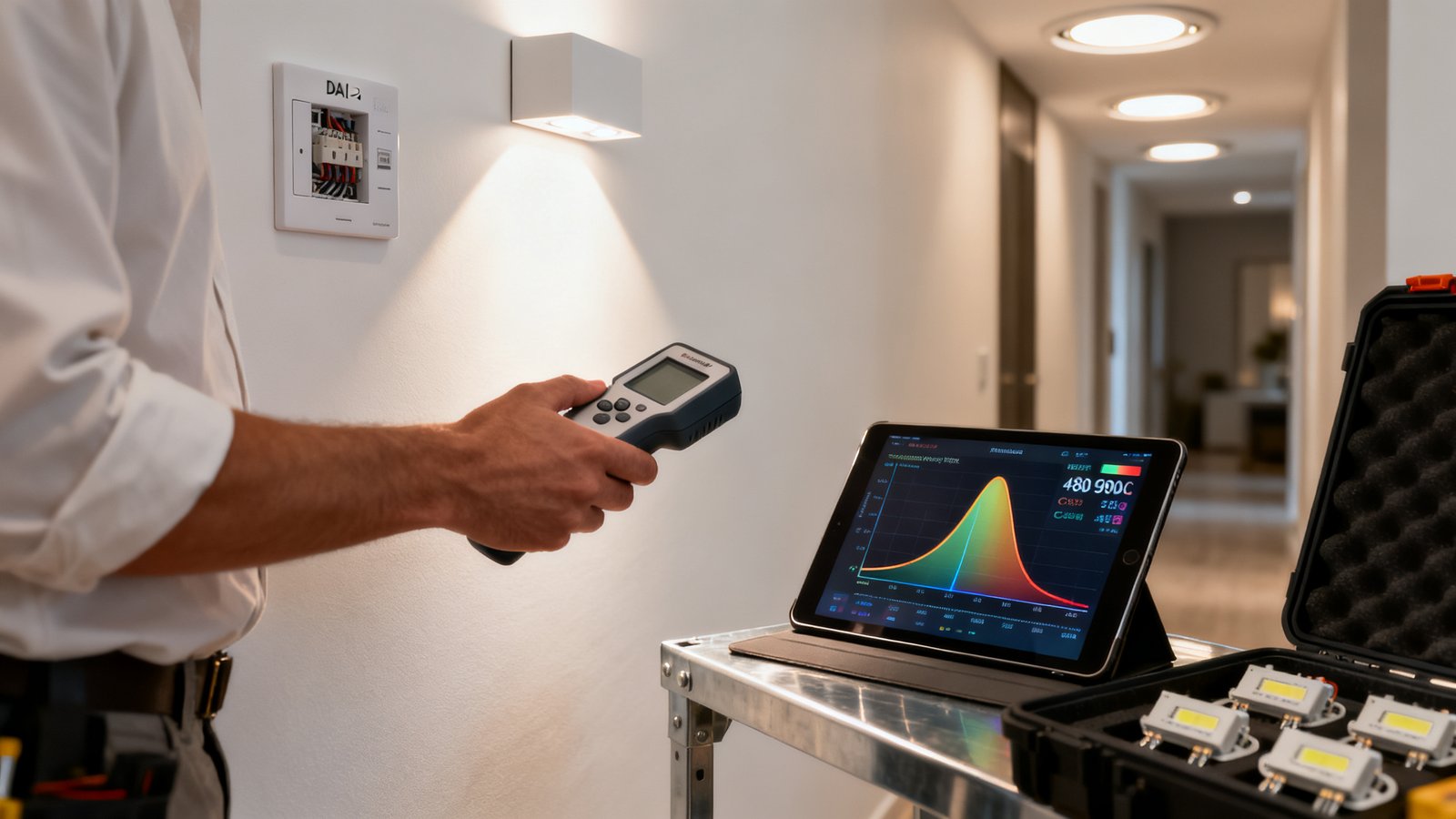
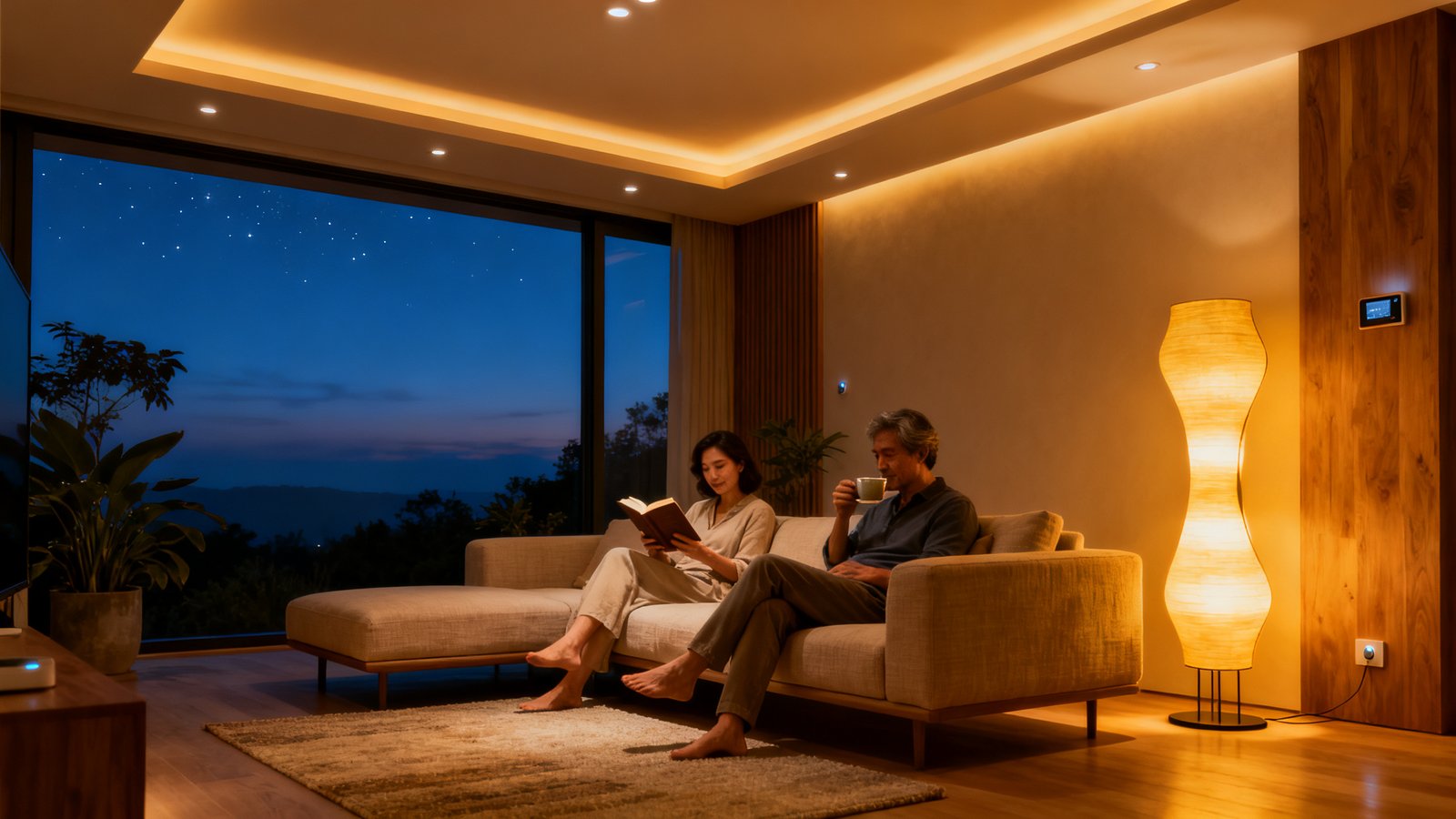
The daytime sustain recipe holds lights at 4000K to 5000K with intensity adjusting based on ambient light sensor input. This counters the post lunch dip in alertness. The evening dim to warm recipe begins around 7 PM, transitioning from 4000K to 2700K over 90 minutes while reducing intensity to 40 to 60 percent of daytime levels. The night time low lux amber mode activates after 10 PM, using 2200K or lower at 5 to 10 percent intensity, just enough for safe navigation without disrupting melatonin.
Recommended CCT transitions follow the standard pattern of 5000K to 6500K in the morning down to 2700K to 3500K in the evening. Systems should support dynamic scheduling with at least four programmable segments per day. Smart bulb selections with dim to warm LED automation can handle these transitions but verify the spectral output at each endpoint.
Emerging topics and gaps competitors miss
Most circadian lighting articles stop at product recommendations and basic scheduling. Several underreported areas deserve attention because they will shape the next three years of residential adoption.
Personalized circadian lighting using wearable biosensors is cited as a future opportunity but rarely covered in depth. Devices like the Oura Ring, Apple Watch, and Whoop already track sleep phase, heart rate variability, and body temperature. The next logical step is feeding that biometric data into the lighting controller so that your morning light dose adjusts based on your actual sleep quality from the previous night. This feedback loop is technically feasible today but lacks standardized APIs between wearable platforms and lighting control systems.
Standardized measurement protocols remain a gap. The industry has not converged on a single verification standard for residential circadian lighting efficacy. IES TM-30 provides color rendering metrics, and melanopic standards exist in research contexts, but there is no ENERGY STAR equivalent for circadian performance. This vacuum allows products with weak spectral performance to make broad health claims. Counterfeit and substandard products from informal supply chains are an identified market threat, with cheap tunable white bulbs flooding online marketplaces that lack any melanopic verification.
Li-Fi, or internet delivered through modulated LED light, is an emerging trend with potential to add data networking value to circadian lighting infrastructure. While still niche in 2026, Li-Fi could justify infrastructure investment in projects where lighting and connectivity budgets are shared. Smart lighting trends for 2026 point to convergence between illumination, wellness, and data as the next frontier.
Product evaluation cheat sheet
Use this checklist when evaluating any circadian lighting product. If the vendor cannot answer these questions with specific numbers, treat the product as tunable white without verified circadian capability.
Must have specs: MEDI or melanopic ratio data referenced to 480 nm, CCT range spanning at least 2700K to 5000K with automated transitions, CRI above 95, R9 above 90, multi channel LED mixing with a minimum of three emitter types, dynamic scheduling with at least four daily segments, and Matter certification for cross ecosystem compatibility.
Red flags include products that only advertise CCT range without spectral power distribution data, systems that require manual scene selection for circadian operation, fixtures with CRI below 90 or unreported R9 values, and any product that cannot export schedule data or integrate with third party automation platforms. Ask vendors directly whether commissioning support and melanopic verification are included in the purchase price. Also verify cybersecurity features including encrypted firmware updates and network segmentation recommendations. Warranty terms below five years on integrated LED fixtures are a warning sign for longevity in a system designed to run daily transitions for a decade or more.
Quick FAQs and next steps for homeowners
Your action plan starts small. Pilot a bedroom or home office with two to four tunable smart bulbs and tested automation. Color bulbs with tunable white modes are an affordable entry point for this experiment. Run the schedule for four weeks and track your sleep quality, morning alertness, and evening wind down experience. If you see measurable improvement, scale to the rooms where you spend the most waking hours.
When scaling, switch to Matter capable multi channel fixtures for living areas and bedrooms. Use consumer tunable bulbs for secondary spaces. Bring in a professional integrator when the project exceeds eight to ten fixtures or when you need per room melanopic verification. Online distribution channels are expanding rapidly, projected at a 15.3 percent CAGR through 2034, making incremental purchases straightforward.
Measure and iterate. A $150 spectroradiometer rental or a calibrated measurement from a lighting designer costs far less than replacing an incorrectly specified system after installation. Commissioning is not a luxury line item. It is the difference between a lighting system that looks adjustable and one that actually shifts your circadian phase.
Conclusion: ROI considerations and when to call a pro
The health and lifestyle return on a properly specified circadian lighting smart home system is tangible: faster sleep onset, improved mood, better daytime focus, and a more natural wake experience. These are daily benefits that compound over years. The financial ROI is harder to quantify but consider that improved sleep quality correlates with lower healthcare utilization, fewer sick days, and better cognitive performance at work.
If your project stays under $500 and uses consumer bulbs with app based scheduling, DIY is appropriate. When the budget crosses $2,000 and involves hardwired fixtures, bring in a lighting designer or integrator who can provide melanopic measurement as part of the commissioning package. The commercial cost benchmarks of $18 to $55 per square foot and the healthcare premium of 25 to 40 percent highlight the threshold where professional involvement and rigorous specification become essential. For most homeowners, the bedroom and home office justify professional attention. Hallways, bathrooms, and utility spaces do not. Invest your budget where you spend your hours, and verify output where your health depends on it.
Start with one room, measure the result, and scale with confidence. The technology is ready. The knowledge gap is the only remaining barrier, and you have now closed it.
Frequently Asked Questions
What is circadian lighting in a smart home?
Circadian lighting in a smart home is a system of spectrally tuned LED fixtures and automated scheduling that adjusts color temperature and intensity throughout the day to support your body’s natural 24 hour biological clock. It targets the 480 nm sensitivity peak of ipRGCs in the retina to regulate melatonin, alertness, and sleep timing.
How much does it cost to retrofit circadian lighting in a home during 2026?
A DIY pilot using two to four tunable smart bulbs costs $60 to $200. A professionally installed single room retrofit with multi channel fixtures, sensors, and a Matter controller runs $800 to $2,000. Whole home retrofits with 20 to 30 integrated fixtures and professional commissioning range from $8,000 to $25,000 depending on fixture grade and control complexity.
Can I use regular smart bulbs for circadian lighting?
Consumer tunable white smart bulbs can serve as an entry point for personal experimentation, especially in a bedroom or home office pilot. However, most use two channel mixing and lack published melanopic specifications. For verified circadian performance, multi channel fixtures with documented MEDI data and dynamic scheduling are required.
Does circadian lighting actually improve sleep quality?
Yes, when properly specified and commissioned. Systems that deliver sufficient morning melanopic stimulus (250 to 500 melanopic equivalent lux at the eye) and reduce melanopic exposure in the evening support faster sleep onset, improved sleep efficiency, and better morning alertness. The key variable is whether the system achieves the intended melanopic dose at the occupant’s eye position.
What smart home platforms work best with circadian lighting in 2026?
Apple Home, Google Home, and Amazon Alexa all support circadian lighting when paired with Matter certified devices. The platform choice matters less than ensuring the automation engine supports smooth CCT transitions and at least four time based scheduling segments per day. Dedicated lighting control systems offer the most precise scheduling and sensor integration.