

If you have ever been locked out because your battery free smart lock was actually a battery powered lock that died at the worst possible moment, you already understand the appeal of a door lock that never needs a battery swap. The Lockin V7 Max promises exactly that experience. It ditches disposable cells entirely and instead draws power wirelessly through an infrared charging system called AuraCharge. But a $1,300 price tag raises a fair question: is eliminating a $15 annual battery run worth a four figure upfront premium?
Key Takeaways
- The Lockin V7 Max uses a dedicated infrared transmitter to deliver power wirelessly up to 4 meters, meaning zero battery replacements and zero ongoing battery costs for the life of the product.
- At roughly $1,300 plus professional installation, the upfront cost is substantially higher than a $299 battery smart lock, but the five year total cost gap narrows considerably when you factor in maintenance time and battery waste.
- Several technology unknowns remain: Thread support is not specified, UWB and Apple Home Key are not mentioned in official materials, and no real world user reviews exist yet since the product only reached preorder stage after CES 2026.
- Why Battery Free Matters
- How Lockin V7 Max AuraCharge Infrared Wireless Charging Works
- Top Features Competitors Cannot Match
- Smart Home Compatibility in 2026
- UWB and Proximity Unlocking Reality Check
- Real World Buying Considerations
- User Feedback and Reliability Gaps
- Five Year Cost Comparison
- Quick Buying Checklist
- Conclusion
- Frequently Asked Questions
Why Battery Free Matters
The core consumer frustration with smart locks is embarrassingly simple. Batteries die. When they do, you are either locked out or you are fumbling with a physical key you stopped carrying two years ago. A smart lock that cannot unlock is just an expensive paperweight bolted to your front door.
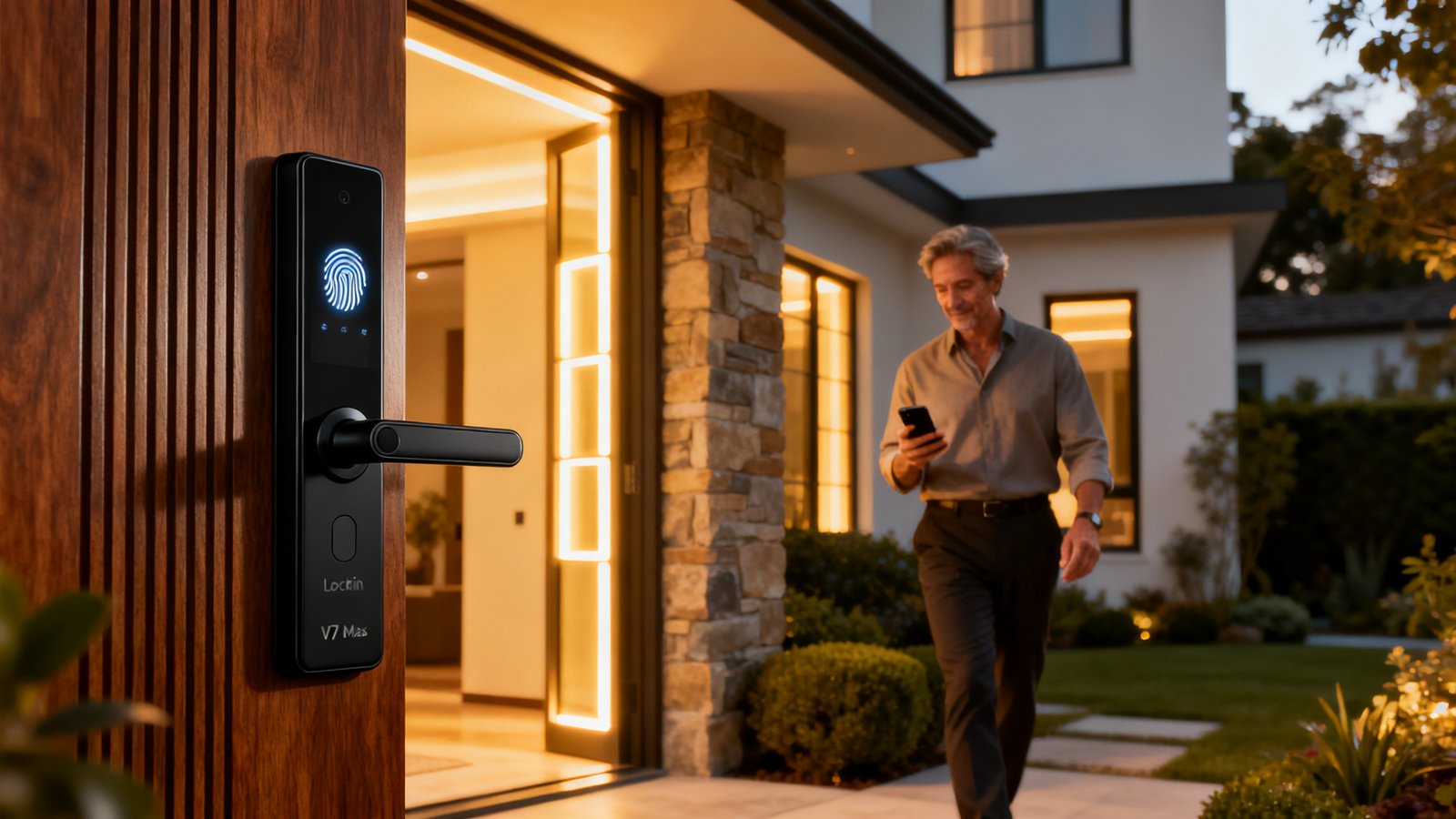
Then there is the environmental math. A typical battery smart lock like the Schlage Encode retails around $299 and eats through four AA batteries roughly once a year. That is $10 to $20 annually in replacement cells. Over five years, you spend $50 to $100 on batteries and toss 20 alkalines into a landfill. Multiply that across a few million households and the waste adds up fast.
But the real cost is not financial. It is reliability. A battery powered lock is only as dependable as your memory to replace the cells before they drain. Most people forget. A smart lock no batteries design eliminates that failure point entirely. The Lockin V7 Max has no user serviceable batteries at all. Ongoing battery costs: $0. That is the pitch. Zero maintenance. Zero interruptions. Zero late night runs to the drugstore for AAs when the low battery warning chirps at 11 p.m.
Framed this way, battery free is not a convenience feature. It is a reliability upgrade. And for a front door lock, reliability is the entire job description.
How Lockin V7 Max AuraCharge Infrared Wireless Charging Works
AuraCharge is not ambient light harvesting. That distinction matters because several early battery free concepts tried to run on indoor lighting or solar and failed spectacularly in dark hallways or during cloudy weeks. Lockin took a fundamentally different approach.
The system uses a dedicated infrared transmitter that actively beams power to a receiver built into the lock. According to Residential Systems, the transmitter pushes power across distances up to 4 meters, or roughly 13 feet. That range gives installers meaningful flexibility. The transmitter can sit on a nearby wall, ceiling, or even across a foyer, so long as there is a clear line of sight to the lock.
Because this is an active infrared optical system, there is no minimum lux requirement. The lock charges regardless of weather, ambient light level, or time of day. A dark entryway at midnight works just as well as a sunlit foyer at noon. Lockin states plainly that AuraCharge “requires no sunlight, no manual charging.”
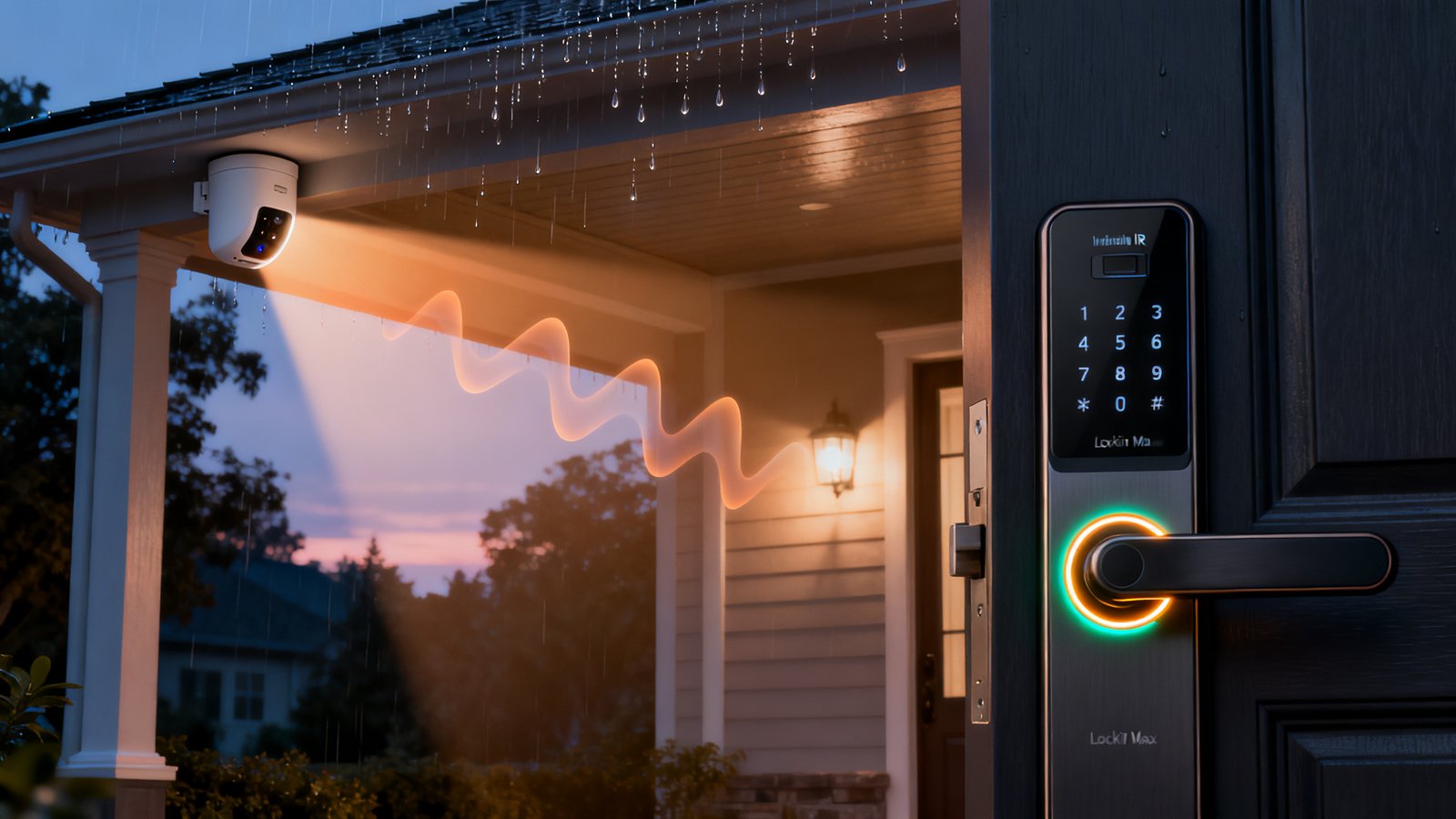
The practical implication for homeowners is straightforward. As long as your installer positions the transmitter correctly and your home has continuous power to that transmitter, the lock receives a steady trickle charge. There is no charging routine to remember. No cables to plug in. The whole system operates passively in the background, which is exactly what a set and forget experience should feel like.
That said, the transmitter itself does need mains power. If your home loses electricity and you lack a backup power source for the transmitter, the lock eventually runs down its internal reserve. Lockin has not publicly specified how long the internal buffer lasts without IR input, so ask your installer for an estimate based on your usage patterns and door activity.
Top Features Competitors Cannot Match
The battery free category is still small, but several products exist. Wi Charge offers a retrofit kit. Alfred has the DB2S. iLOQ uses kinetic energy harvesting. What the Lockin V7 Max smart lock brings to the table goes well beyond the power system.
The first headliner is the triple biometric suite. Most smart locks with biometrics settle for a single fingerprint sensor. The V7 Max packs finger vein recognition, palm vein recognition, and 3D facial recognition into one device. Vein patterns are nearly impossible to spoof because they require blood flow. Facial recognition adds hands free entry when your arms are full of groceries. No other battery less smart lock technology on the market combines all three modalities. Competitors typically offer one biometric method at most and often pair it with a basic PIN pad.
The second differentiator is the dual 5 inch touchscreens. There is a screen on the exterior for visitors and delivery personnel, and a screen on the interior for household members. This is not just a cosmetic flourish. It enables video calling, package detection alerts, and a visual activity log that you can check without opening a phone app. No other battery free lock in the current research set offers dual displays.
The third standout is LockinAI. This is an onboard intelligence layer that runs 10 core scenarios including package theft prevention, video indexing, and motion based smart alerts. A smart deadbolt with integrated AI reduces dependence on separate cameras and cloud subscriptions. The system can distinguish between a delivery person setting down a box and someone loitering suspiciously, then alert you accordingly. Competitor locks in the battery free space simply do not have an AI engine at this level.
Design pedigree also deserves a mention. The V7 Max was shaped by Hartmut Esslinger, Apple’s former chief designer. The industrial design is clean, minimal, and noticeably more refined than the utilitarian look of most keypad deadbolt units on the market.
Smart Home Compatibility in 2026
Matter support is the headline here, and it is confirmed. The Lockin V7 Max fully supports the Matter protocol and integrates with ecosystems from Google, Apple, Amazon, and Samsung according to Lockin’s CES 2026 announcement. This means the lock can join a smart home routine alongside thermostats, lights, and sensors without proprietary bridges or workarounds.
But Matter is a protocol, not a transport. The distinction between Matter over Wi Fi and Matter over Thread is significant. Thread creates a low power mesh network that is ideal for battery operated devices. Since the V7 Max is not battery operated, Wi Fi may be the chosen transport. Lockin has not specified whether Thread is supported. For buyers building a Thread based smart home, this is an open question worth asking before purchase.
The absence of clarity around Thread does not break the product. Wi Fi based Matter devices work fine in most homes. But if you are investing in a predictive smart home system that relies on Thread’s mesh topology for reliability, you will want a definitive answer from Lockin or your installer before committing.
UWB and Proximity Unlocking Reality Check
Ultra Wideband, or UWB, is the technology behind precision phone based unlocking. It lets your door detect exactly when you are approaching and unlock passively without you touching anything. Apple Home Key uses UWB in combination with NFC to deliver this experience on recent iPhones and Apple Watches.
Here is what the sources actually say about UWB on the Lockin V7 Max: nothing. The advertised unlocking methods are the triple biometric suite, PIN codes, and app based controls. Apple Home Key is not listed. UWB is not mentioned in any Lockin specification or CES coverage as of early 2026.
This does not mean UWB is absent. It means it is unconfirmed. If passive phone based unlocking is a must have feature for you, verify UWB and Apple Home Key support directly with Lockin or an authorized dealer before ordering. Otherwise, assume you will be using biometrics or the app for entry.
For context, many premium smart locks in 2026 are adding UWB, and the standard is becoming table stakes in the $500 and above category. A UWB smart lock 2026 buyer has several alternatives if passive unlock is non negotiable. Lockin’s silence on the topic is one of the more significant gaps in the V7 Max story.
Real World Buying Considerations
The Lockin V7 Max is not a DIY product. Professional installation is required, and the estimated retail price hovers around $1,300 before installation labor. Installation cost varies by region, door type, and the complexity of positioning the AuraCharge transmitter, but a reasonable expectation is several hundred dollars on top of the hardware price.
Timeline matters too. The V7 Max was announced at CES 2026 and was available for preorder with shipping expected in early March 2026. If you are reading this in mid 2026 or later, check current availability and lead times. Early production runs of complex hardware often sell out quickly.
Door geometry is the practical constraint most buyers overlook. The AuraCharge transmitter needs a clear line of sight to the lock face. If your entryway has an unusual angle, a recessed door frame, or decorative glass panels that scatter infrared light, the installer may need to get creative with placement. Ask about this during the quote stage.
Warranty and service expectations are also unproven. As a new product category with a novel power delivery system, long term service data does not exist. Request written warranty terms that cover the transmitter, the lock body, and the internal rechargeable buffer. Understand what happens if the transmitter fails after year two.
The battery free smart lock category is exciting but immature. Early adopters bear the risk of unproven longevity. The reward is genuine zero maintenance ownership. Weigh that tradeoff honestly.
User Feedback and Reliability Gaps
At the time of the sources, the Lockin V7 Max had no published user reviews. It was announced at CES 2026 and only reached preorder status. No complaints about the wireless charging system have surfaced, but that is because the product had not yet shipped to consumers.
This lack of data is not a red flag. It is a blank slate. Every first generation product enters the market this way. The responsible approach is to ask for evidence of pilot installations or installer references. A reputable dealer should be able to share feedback from early deployments or at minimum demonstrate the lock functioning on a test door.
Pay attention to warranty duration. A longer warranty signals manufacturer confidence in a new technology. If Lockin offers a standard one year warranty on a $1,300 lock with an unproven infrared charging system, factor that into your risk assessment. Two years or more would be more appropriate for a category defining product.
Also ask about the internal battery buffer. Even though the lock has no user replaceable batteries, it almost certainly contains a rechargeable cell that stores the IR harvested energy. All rechargeable batteries degrade over time. Understand whether that internal cell is serviceable by a technician and what replacement costs look like five or seven years down the road.
Five Year Cost Comparison
Below is a simplified five year total cost of ownership comparison between the Lockin V7 Max and a representative battery smart lock, the Schlage Encode. All figures are estimates. Installation costs for the Schlage are assumed at $0 for a competent DIY install. Lockin installation is estimated at $300 based on typical professional smart lock labor, though actual costs vary.
| Cost Category | Lockin V7 Max | Schlage Encode |
|---|---|---|
| Hardware (MSRP) | $1,300 | $299 |
| Installation | ~$300 (est.) | $0 (DIY) |
| Battery cost (5 years) | $0 | $50–$100 |
| Estimated 5 Year TCO | ~$1,600 | $349–$399 |
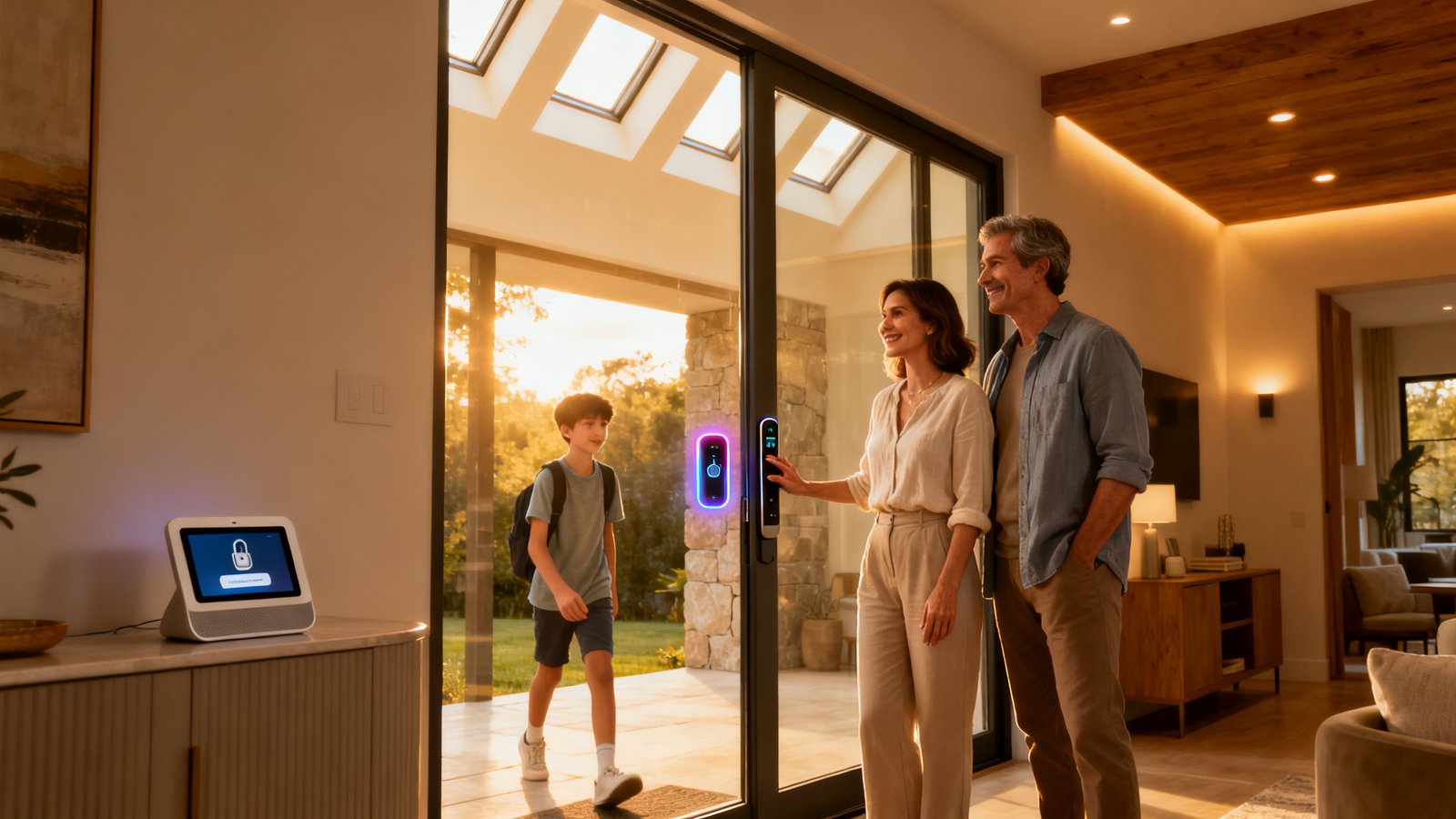
The raw numbers show a roughly $1,200 gap over five years. But this model deliberately excludes several factors that matter to the target buyer. It excludes the time cost of battery changes, the security risk of a dead lock, the environmental cost of 20 alkaline batteries, and the value of features the Schlage Encode simply does not offer: triple biometrics, dual touchscreens, and onboard AI.
If you value those features at zero dollars, the math favors the battery lock. If you assign real value to never thinking about batteries again and having vein based biometric security, the gap shrinks fast. A smart home energy management system mindset applies here: look at total cost across the full ownership period, not just the sticker price.
The installation cost is the biggest unknown variable. If your door requires a complex transmitter mount or structural modifications, the Lockin installation could run $500 or more. Get a firm quote before comparing totals.
Quick Buying Checklist
Before you commit to the Lockin V7 Max, run through these verification questions with your dealer or installer:
- Installation cost: Request a written quote that includes the AuraCharge transmitter placement and any door modifications.
- Matter transport: Confirm whether the lock uses Matter over Wi Fi, Thread, or both. Get the answer in writing.
- UWB and Apple Home Key: Ask explicitly if either is supported or planned via firmware update. Do not assume.
- Warranty terms: Verify coverage duration for the lock body, the IR transmitter, and the internal rechargeable cell.
- Pilot installations: Ask if the installer has completed any V7 Max deployments and whether you can speak with those clients.
- Internal battery service: Understand whether the internal cell is technician replaceable and what the projected replacement cost is.
- Power backup: Clarify how long the lock operates if the IR transmitter loses mains power and whether a backup power option exists.
Conclusion
The Lockin V7 Max is the most ambitious entry in the battery free smart lock category to date. Its AuraCharge system solves the battery problem elegantly, and the feature set, from triple biometrics to dual touchscreens to LockinAI, runs laps around every other battery less option currently available.
But ambition cuts both ways. The $1,300 price plus professional installation puts it in a tier where buyers should demand proof, not promises. Confirmed Matter support is excellent. Unconfirmed Thread, missing UWB, absent Apple Home Key, and zero real world user data are gaps that pragmatic buyers should probe before handing over a credit card.
If you prioritize zero maintenance ownership and are willing to pay a premium for a genuinely innovative battery free smart lock, the V7 Max deserves a spot on your shortlist. Just go in with clear expectations and a checklist of questions. The technology is real. The long term reliability story is still being written. Your job as a buyer is to make sure you are comfortable being part of that story. Keyless deadbolt alternatives exist at lower price points, but none deliver the set and forget promise quite like this one.
Frequently Asked Questions
Does the Lockin V7 Max require any batteries at all?
No. The lock has no user serviceable batteries. It contains an internal rechargeable cell that charges wirelessly via the AuraCharge infrared transmitter. You never need to buy or replace disposable batteries for the lock itself.
What happens if the infrared transmitter loses power?
The lock runs on its internal rechargeable buffer when the transmitter is offline. Lockin has not publicly specified the buffer duration. If your home experiences an extended power outage and the transmitter has no backup power, the lock will eventually deplete its reserve. Ask your installer about estimated buffer life based on your usage patterns.
Is the Lockin V7 Max compatible with Apple Home Key?
Apple Home Key is not listed among the advertised unlocking methods. The lock supports Matter and integrates with Apple’s ecosystem, but passive Home Key unlocking via UWB or NFC has not been confirmed. Verify directly with Lockin if this feature is critical for you.
How much does professional installation cost for the Lockin V7 Max?
Installation cost is not standardized and varies by region, door type, and transmitter placement complexity. A reasonable estimate is $300 to $500, but complex installations could run higher. Always request a written quote before purchase.
Can the Lockin V7 Max work with my existing smart home system?
The lock supports the Matter protocol and integrates with ecosystems from Google, Apple, Amazon, and Samsung. If your smart home platform supports Matter, basic compatibility is likely. Thread support has not been specified, so confirm transport compatibility with your specific setup.